The Museum Is Open Today 10 Am - 5 Pm
nI learned this lesson the hard way. I had a beautiful amethyst bracelet that I loved — deep purple, perfectly faceted, caught light like tiny stained glass windows. One day I noticed it looked dull. Dusky. Sad. So I did what anyone would do: I tossed it in an ultrasonic cleaner and let it run its cycle.nnTwenty minutes later, I pulled out a bracelet with cloudy, cracked stones. The ultrasonic vibrations had found every natural fracture in the amethyst and widened them into visible lines. The bracelet was ruined — not because I was careless, but because I didn’t know that different stones need different care.nnI’ve learned a lot since then. Here’s everything you need to know to keep your gemstone jewelry radiant without accidentally destroying it.n
Quick Answers: Gemstone Jewelry Care
n
Can I use an ultrasonic cleaner for gemstone jewelry?
n
No — ultrasonic cleaners damage stones with natural fractures like amethyst, opal, and moonstone. Stick to lukewarm water and mild soap instead.
n
How often should I clean my gemstone bracelet?
n
Wipe with a dry cloth daily (30 seconds). Do a deep clean with mild soap once a week. Some stones — opal, malachite, turquoise — should never be submerged.
n
Can I shower with my gemstone jewelry on?
n
It’s best not to. Soap scum builds up and creates a dull film, and hot water can weaken the stretch cord in bracelets.
nn
Why Different Stones Need Different Care
nHere’s the thing nobody tells you: gemstones are not all the same hardness. The Mohs hardness scale ranges from 1 (talc, soft enough to scratch with your fingernail) to 10 (diamond, virtually unscratchable). The problem is that most jewelry care advice treats all stones as if they’re diamonds — and they’re not.nnHere’s how common jewelry stones rank on the Mohs scale and what that means for care:n
- n
- Tiger Eye (7): Fairly tough, but can fracture on hard impact. Safe for most cleaning methods.
- Rose Quartz (7): Durable but color fades with prolonged sun exposure. Keep out of direct sunlight.
- Jade (6-7): Durable but porous — absorbs oils, lotions, and perfume. Needs gentle cleaning only.
- Moonstone (6-6.5): Soft. Chips and scratches easily. Handle with care, store separately.
- Obsidian (5-5.5): Scratches easily despite being volcanic glass. No abrasive cleaners.
- Opal (5.5-6): Contains water in its molecular structure. Can crack if it dries out or is submerged too long.
- Lapis Lazuli (5-6): Contains pyrite inclusions that can rust. Avoid water submersion.
- Turquoise (5-6): Highly porous. Absorbs water, oils, and whatever else it touches. Stains easily.
- Malachite (3.5-4): Very soft and porous. Sensitive to water, heat, and acids. Wipe only.
- Howlite (3.5): Extremely porous. Stains easily. Keep away from water, lotion, and colored fabrics.
n
n
n
n
n
n
n
n
n
n
nThe takeaway: one-size-fits-all cleaning doesn’t exist. What works for tiger eye will ruin howlite.n
The 30-Second Daily Habit
nThis single habit will do more for your gemstone jewelry than any deep cleaning method. Every night before bed, wipe each piece with a dry microfiber cloth. Fifteen seconds per piece. That’s it.nnWhy this matters: your skin produces oils, sweat, and dead skin cells. Your lotion and perfume leave residue. Dust and pollution settle on exposed surfaces. Left overnight, these accumulate into a dull film that makes even the most beautiful stone look lifeless.nnThirty seconds per day keeps your pieces bright for years instead of months. It’s the simplest habit I’ve adopted, and it makes the biggest difference.nn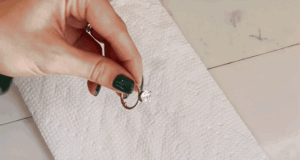 n
n
Weekly Deep Clean (5 Minutes)
nFor stones that can handle it (check the list above), a weekly deep clean keeps them looking fresh:n
- n
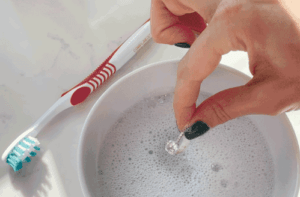
- Fill a small bowl with lukewarm water — not hot, not cold. Hot water can damage porous stones and weaken the stretch cord in bracelets.
- Add one drop of mild dish soap. Nothing with bleach, ammonia, or moisturizers. Plain Dawn or equivalent is perfect.
- Soak for 2-3 minutes. No longer — porous stones can absorb too much water.
- Gently scrub with a soft toothbrush (dedicated for jewelry, not your toothbrush). Focus on the gaps between beads where grime collects.
- Rinse under lukewarm running water until soap is gone.
- Pat dry with a soft, lint-free cloth. Let air dry completely — at least an hour — before storing.
n
n
n
n
n
n
n
⚠️ Stones That Cannot Get Wet
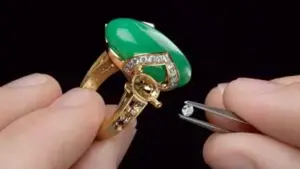
nThese stones should NEVER be submerged in water. For these, the only cleaning method is a barely damp cloth, wiped gently, dried immediately:nnOpal: Contains natural water. Submersion can cause crazing (tiny cracks throughout the stone).nnMalachite: Extremely porous. Water will be absorbed and can cause discoloration. Also sensitive to acids and heat.nnTurquoise: Highly porous. Water absorption can permanently change the color. Also absorbs lotions and perfumes easily.nnPearl: Organic, not mineral. Water weakens the nacre and can cause peeling. Wipe with a barely damp cloth and dry immediately.nnLapis Lazuli: Contains pyrite inclusions. Water can cause the pyrite to rust, creating brown spots in the deep blue stone.nnFor these stones: dip a microfiber cloth in water, wring it out until barely damp, gently wipe the stone, then immediately pat dry with a soft cloth.n
n
What NOT to Do — Ever
nI’ve made most of these mistakes so you don’t have to:nnNo ultrasonic cleaners. The high-frequency vibrations damage stones with natural fractures — which is most gemstones. Amethyst, moonstone, opal, emerald, and turquoise are particularly vulnerable.nnNo steam cleaners. The heat and pressure can crack stones, especially opal, emerald, and stones with inclusions.nnNo jewelry cleaning dips. Commercial jewelry cleaners often contain ammonia, which is too harsh for porous stones. It can strip the polish and dull the surface.nnNo toothpaste. Common advice on the internet. Do not fall for it. Toothpaste contains abrasives designed to scrub enamel off teeth. It will scratch gemstone surfaces, especially softer stones like howlite, turquoise, and moonstone.nnNo overnight soaking. Even for “hard” stones, prolonged submersion can weaken the setting, the cord, and the stone itself. Two to three minutes is the maximum.nnNo baking soda or vinegar. These create a chemical reaction that can damage stones. Stick to mild dish soap and water.n
Storage Tips
nHow you store your gemstone jewelry matters almost as much as how you clean it:nnSeparate compartments. Gemstones can scratch each other. Store each piece in its own pouch, compartment, or wrapped in a soft cloth. A jewelry box with divided sections is ideal.nnAvoid sunlight. Direct UV light fades colored stones over time. Amethyst, rose quartz, citrine, and turquoise are especially vulnerable. Store in a dark, cool place.nnNo humidity. Bathrooms are the worst place for jewelry storage. The moisture and temperature fluctuations are hard on both stones and metals. Store in a bedroom or closet instead.nnSeparate from metal jewelry. Metal chains and findings can scratch gemstone surfaces during storage. If you’re storing multiple pieces together, wrap each one.n
n
When to Remove Your Jewelry
nI know, I know — you want to wear your favorite piece all day every day. But certain activities are hard on gemstones:nnShowering: Soap scum builds up on stones and creates a dull film. Also, hot water can weaken stretch cords.nnSwimming: Chlorine damages both stones and metal. Salt water can be corrosive.nnApplying lotion, perfume, or sunscreen: Let these absorb into your skin for at least 30 seconds before putting on jewelry. The chemicals can dull stones and corrode findings.nnSleeping: Unless the piece has deep sentimental meaning, take it off. You can crack a stone against your bed frame or nightstand without realizing it.nnExercise: Sweat is slightly acidic and can dull stones over time. Also, impact from weights or equipment can crack softer stones.nnCooking: Grease and heat are bad for stones. Take off rings and bracelets before handling raw ingredients or standing over a hot stove.n
Energy Cleansing (Optional, But Meaningful)
nBeyond physical cleaning, many traditions recommend cleansing the energy of gemstones. Here’s what actually works without damaging your stones:nnMoonlight charging: The safest and most universal method. Leave your stones under a full moon overnight. This works for all stones and doesn’t risk damage. New moons are for setting intentions; full moons are for charging and cleansing.nnSelenite: Place your stones on a selenite slab or next a selenite wand overnight. Selenite is a self-cleansing crystal — it absorbs and neutralizes negative energy from other stones without needing anything itself.nnSmudging: Pass your jewelry through sage or palo santo smoke. A few seconds is enough. Make sure the smoke touches every stone.nnAvoid these methods:n
- n
- Salt water: Salt scratches stones and can dehydrate porous ones. Despite being a common recommendation, it’s one of the worst things you can do.
- Sun exposure: Sunlight fades colored stones. Amethyst turns pale, rose quartz goes gray, citrine loses its golden warmth. Never leave stones in direct sun for energy cleansing.
- Rice or soil: Particles get trapped in settings and scratch surfaces. Not worth it.
n
n
n
n
n
What to Do When a Stone Breaks
nThis happens. You knock your wrist against a doorframe and hear that sickening crack. Or you look down at your favorite bracelet and notice a stone has split.nnIn many traditions — Chinese jade culture, Hindu gemstone lore, and Western crystal healing alike — a stone that breaks is believed to have absorbed an impact meant for you. It did its job. The crack is evidence that it protected you from something.nnIn Chinese tradition especially, a jade bangle that cracks during wear is said to have shielded the wearer from misfortune. You do not repair it. You thank it, you bury it or place it in natural running water, and you move on.nnYou can certainly restring a bracelet with a new replacement stone. But the broken stone itself has completed its purpose. Let it go.nnYour gemstone jewelry carries millions of years of geological history in every bead. A little care — the right care — will keep it carrying beauty for years to come.nn
✨ Ready to find your perfect gemstone?
n
Browse our handcrafted gemstone bracelets — each piece selected for quality and meaning. Free shipping on orders over $99.
n