The Museum Is Open Today 10 Am - 5 Pm
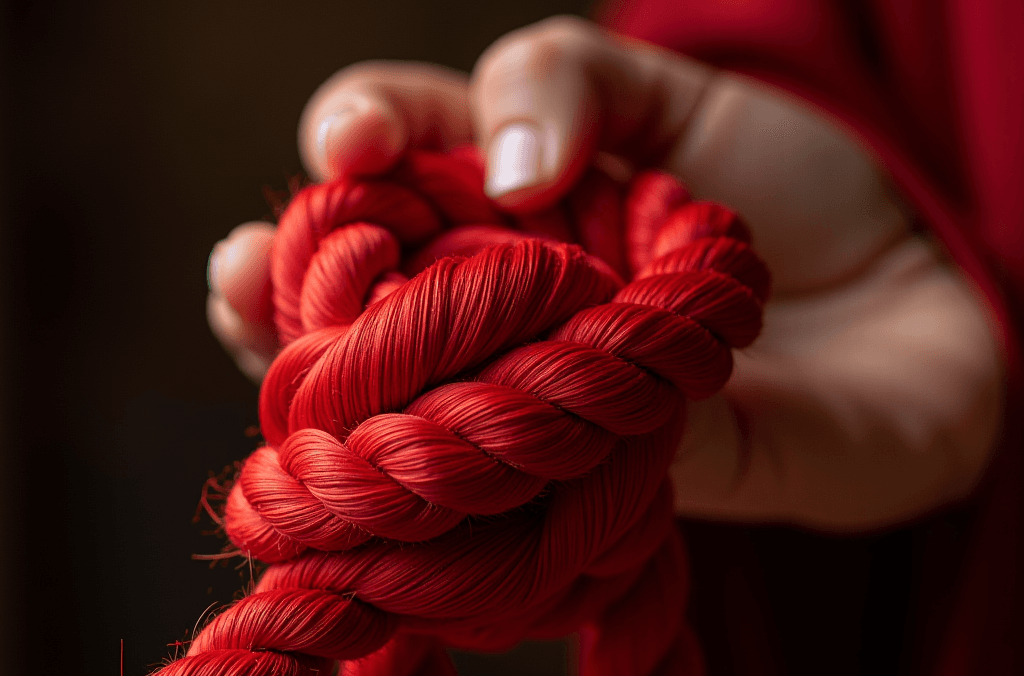
Walk through any Chinatown and you’ll see them hanging in shop windows, dangling from rearview mirrors, woven into bracelets and earrings. Tangles of cord tied into symmetrical patterns that look both ancient and modern. Most people walk past without a second glance.
But the Chinese knot is one of the most sophisticated symbolic systems ever developed through craft. Before writing, before coins, before the Silk Road — there were knots.
Quick Answers
What does the Chinese knot symbolize?
The Chinese knot (中国结) represents unity, prosperity, and the continuity of life. Its endless, interlocking pattern symbolizes eternal blessing with no beginning or end.
What is the most popular Chinese knot style?
The Pan Chang knot (also called the endless knot) is the most recognized — its symmetrical, interconnected loops represent karma, cause and effect, and the cycle of life.
Can I wear a Chinese knot as jewelry?
Yes — Chinese knots are commonly worn as bracelet charms, necklace pendants, and earrings. Red knots are especially popular for luck and protection.
The Pre-History of Chinese Knotting
The earliest archaeological evidence of Chinese knotting dates back 8,000 to 10,000 years. These were not decorative. They were a memory system — different knots and cord colors recorded information about taxes, population counts, and calendar events.
By the Zhou Dynasty (1046-256 BCE), knots had evolved into decorative art. The ruling class used jade pendants tied with silk knots as status symbols. The complexity of the knotwork on a noble’s belt indicated their rank.
The Tang Dynasty (618-907 CE) was the golden age. Silk production had peaked, the Silk Road was open, and cultural exchange with Persia and India introduced new techniques. Women of the court competed to create the most beautiful and complex knots.
By the Ming and Qing Dynasties (1368-1912), Chinese knotting had become a codified art form with over twenty distinct styles, each with specific names, meanings, and uses.
8 Essential Knot Styles and Their Meanings
1. Pan Chang Knot — The Endless Knot
The most recognizable Chinese knot. It’s an endless, symmetrical loop with no visible beginning or end. In Buddhism, it represents infinite wisdom and compassion. In daily life, it symbolizes eternity and interconnectedness.
Best for: Long-term intentions, wedding jewelry, family heirlooms.
2. Button Knot — The Clasp of Connection
Originally used as an actual button on traditional Chinese clothing, the button knot is tight and round. It represents a secure bond that can be undone, but only with deliberate effort.
Best for: Friendship bracelets, partner gifts, pieces meant to be opened and closed.
3. Double Coin Knot — Wealth and Abundance
This knot takes its shape from the ancient Chinese coin: a circle with a square hole. The shape represents heaven (round) and earth (square). Two interlocking coin shapes double the meaning.
Best for: Career growth pieces, prosperity charms, business intentions.
4. Cloverleaf Knot — Fourfold Blessing
Each petal represents one of four fundamental blessings: luck, wealth, longevity, and happiness. When all four are in harmony, the knot is said to create complete good fortune.
Best for: All-purpose blessing, gift wrapping, versatile jewelry.
5. Cross Knot — The Meeting Point
Two intersecting cords create a central point where heaven and earth meet. It symbolizes convergence — fated encounters, important decisions, turning points.
Best for: Life transitions, new beginnings, protective talismans.
6. Caisson Ceiling Knot — Rising Fortune
Named after temple ceiling panels, this knot builds upward in layers. Each level represents a step toward success. Most effective with at least three layers — past, present, future.
Best for: Career advancement, spiritual growth, long-term aspirations.
7. Ruyi Knot — As You Wish
Inspired by the ruyi scepter, a ceremonial object associated with power and wish-granting. The knot has a smooth, flowing pattern like a stylized cloud — in Chinese culture, clouds carry rain and obscure the view of envious spirits.
Best for: Wishes and manifestations, creative projects, general good fortune.
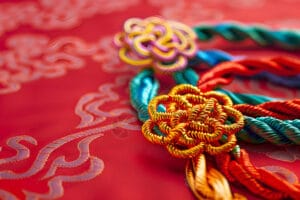
8. Happiness Knot — Double Happiness
This knot forms the character for happiness through its weave. Repeated as double happiness, it becomes the most important wedding symbol in Chinese culture.
Best for: Weddings, relationship milestones, celebrations.
How Chinese Knots Are Made
Despite their complexity, all Chinese knots start with a single continuous piece of cord. No cutting, no splicing, no adhesives. The entire knot is formed by looping, twisting, and tightening the same thread.
This is intentional. The unbroken cord represents the unbroken thread of life connecting ancestors to descendants. A cut cord breaks that continuity.
The process follows strict rules:
Symmetry is mandatory. Every knot must be visually balanced. The left and right sides must mirror each other — representing the balance of yin and yang.
No loose ends. Every cord end must be incorporated back into the knot or finished with decoration.
Consistent tension. The cord must be pulled with equal force at every point. An uneven knot is symbolically unstable.
Why It Matters Today
In an age of mass production, the Chinese knot stands as a reminder that the best things are still made by hand. A machine cannot tie a proper Chinese knot. Each one requires human fingers, human judgment, human patience.
Wearing a Chinese knot bracelet means carrying that tradition. Every time you look at the pattern, you’re seeing hours of practice by someone who learned a craft passed down for generations. The knot isn’t just a design — it’s a conversation between the past and the present.
✨ Discover jewelry with meaning at Blessglow
Browse our handcrafted gemstone bracelets — each piece selected for quality and meaning. Free shipping on orders over $99.